Overview
Over the past five years, our data shows that trade resilience has deteriorated in 157 countries. These countries collectively account for more than 90% of global trade, including top import economies like the US; manufacturing hubs such as Vietnam and Indonesia; apparel producers such as Cambodia and Bangladesh; and commodity-linked markets such as Chile, Peru, DR Congo, Saudi Arabia and Russia.
While supply chain vulnerability was once associated with fragile or peripheral markets, it is now embedded across the world's most consequential trade corridors, including manufacturing hubs, commodity suppliers, logistics centres, and import economies. The pressures driving this supply chain “squeeze” – from trade protectionism and geopolitical realignment, to regulatory fragmentation and spreading conflict – are no longer isolated disruptions. They are becoming structural features of the global trading environment that businesses must learn to navigate as a matter of course.
For companies and investors, this shift carries far-reaching implications: higher input costs, longer lead times, quality and safety concerns, supplier concentration risk, and mounting pressure to redesign global value chains from the ground up. Central to this redesign will be how boards and executives across every sector rebalance their exposure – across sourcing strategies, logistical networks, and supplier relationships. The capacity to anticipate where resilience is weakening, and to act before disruption strikes, will increasingly separate organisations that merely manage supply chain risk, from those that turn it into competitive advantage.
Figure: Global supply chain risk is rising as trade resilience weakens
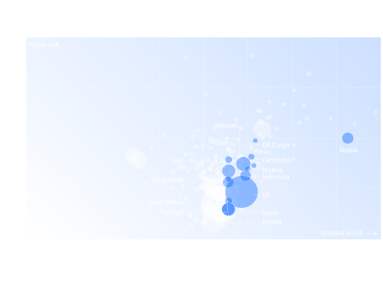
About the Trade Resilience Index: The Trade Resilience Index assesses a country’s ability to withstand global trade disruption, including through trade imbalances, the diversity of its trading relationships and the risks associated with key trade partners. For supply chain leaders, this matters because disruption does not have to originate in a direct sourcing market to affect the movement of goods, commodities or critical inputs. Risk can also be transmitted through the trade relationships, dependencies and partner exposures that sit behind those markets.
For this Supply Chain Risk Outlook, we’ve combined our proprietary Global Risk Data with expert insight from our team of analysts, to reveal the opportunities and threats facing global supply chains in 2026.