Key Takeaways
- A third of the world's busiest ports and airports carry significant risk exposure across geopolitical, environmental and domestic security factors
- Geopolitical and conflict risk is most widespread threat, with nearly a quarter of global busiest ports rated high or very high risk
- Multinational businesses must identify and monitor the risks affecting critical supply chain infrastructure hubs to predict and avoid future disruption
The ongoing 2026 Hormuz crisis has demonstrated how fast-moving events can undermine well established supply chain strategies and logistics hubs. Traditional responses to disruption are no longer sufficient when shocks arrive faster than strategies can adapt. But where, and most importantly how, should supply chain professionals be looking for the next shock?
Beyond the obvious chokepoints, including the Taiwan Strait, the Panama Canal, the Malacca Strait and the Red Sea, maritime ports handle around 80% of global trade by volume, and airports 25%-35% of goods by value. Our data shows that approximately a third of the world’s busiest ports and airports are vulnerable to disruption from at least one or even multiple types of operational shock stemming from geopolitical and conflict factors to environmental risk and domestic security threats.
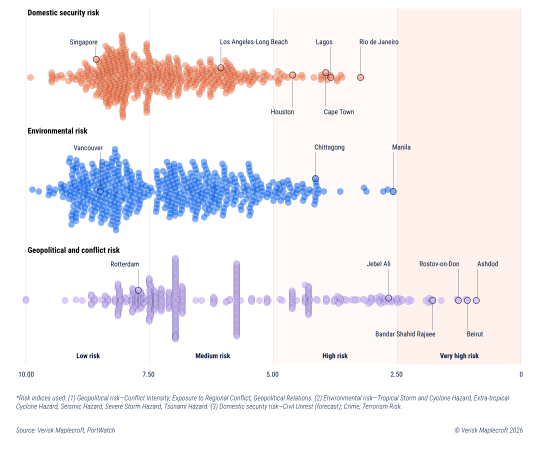
Figure 1: Geopolitical and conflict-related risks are one of the greatest threats to global ports
Dynamic, disruptive events linked to geopolitics, conflict, civil unrest, terrorism and natural hazards are, by their nature, hard to predict. However, by tracking risk trends, pinpointing the exposure of key nodes in the supply chain, and understanding the underlying factors driving potential threats, multinational organisations can be better prepared for the next shock.
Over a third of busiest global ports face a variety of risks threatening closure
Our data shows that 176 out of the 500 busiest ports score high or very high risk on at least one of the three metrics we have used to categorise risk types – geopolitical and conflict, environmental, and domestic security.
As drivers of growth and pillars of regional economic development, ports are one of the most critical nodes for supply chains and where disruptions can have nationwide consequences. A 2022 study by the National Association of Manufacturers estimated that one day of closure at the port of Los Angeles-Long Beach would result in a $520 million USD loss in US GDP.
Major logistics hubs increasingly constitute geopolitical targets, in their role as focal points for strategic interests, economic dependencies, and even global power struggles. Our data shows 23.6% of the 500 busiest global ports are rated high or very high risk for geopolitical and conflict exposure. Outside of Hormuz-related disruption at Jebel Ali Port (UAE) and Salalah Port (Oman), Odesa (Ukraine) and nearby Black Sea ports – as well as Tripoli and Benghazi (Libya), and the Port of Sudan – are all recent examples of major closures stemming from conflict.
Additionally, 9% of the busiest ports are rated high or very high risk for environmental exposure. This includes tropical and severe storm hazards, tsunami hazards, seismic hazards, and heatwave hazards – all of which can cause significant port disruption lasting from days to months.
In 2021, Typhoon Rai closed dozens of ports across Malaysia and the Philippines critical to electronics and semiconductor supply chains. Major US ports across Texas, Louisiana and Florida face recurring disruption from annual hurricane activity, and the 2024 US port strikes demonstrated how quickly civil unrest can bring key gateway ports to a standstill, with ripple effects felt across global trade flows within days.
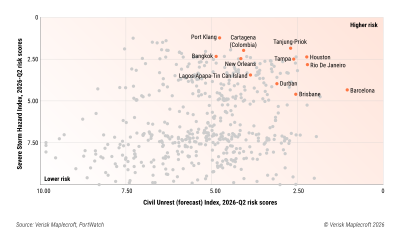
Figure 2 illustrates why risk must be assessed at both macro and micro levels simultaneously – regional aggregates can mask acute vulnerability at individual sites. A port that appears at moderate risk in a system-wide view may face unique location-specific challenges. Procurement executives need both lenses: macro to anticipate where systemic pressure is building, micro to pinpoint exactly where it will hit their supply chain infrastructure.
Airports at risk as multinational businesses pivot to air freight
While its share of global trade volume is significantly less than maritime shipping, air freight occupies a critical transport niche for urgent, valuable and perishable goods – including semiconductors, pharmaceuticals, fresh produce and ecommerce shipping – accounting for an estimated 35% of world trade by value, according to the International Air Transport Association.
Hormuz-related disruption has seen global air freight rates spike as demand rapidly increases from businesses hoping to circumvent the logistical barriers currently faced by maritime shipping. However, our data shows that 30% of the 50 busiest airports globally register as high risk on one or more of our geopolitical and conflict, environmental, and domestic security risk indicators.
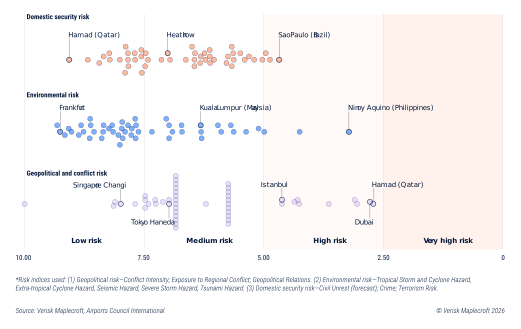
Geopolitical tensions and conflict can affect air freight networks as quickly as maritime equivalents. The Iran War has severely disrupted airports across the Middle East, with nine major airports across the region seeing a 52% year-on-year decline in cargo transported in March-April 2026 according to the Airports International Council. In 2025, Denmark experienced significant disruption across the country’s airports due to alleged Russian-linked drone overflights – the Russia-Denmark relationship scores as “high risk” on our Geopolitical Relations Index.
Fast-moving disruption can overtake strategies in hours – what can supply chain executives do next?
When approximately a third of the world's busiest ports and nearly as many critical cargo airports carry high or very high risk exposure across geopolitical, environmental, and security factors simultaneously, the question is no longer when your network will face a major shock, but how many it will face at once.
Resilience strategies built around single-point contingencies and long adaptation windows are increasingly insufficient. The supply chain leaders who will navigate this environment most effectively are those who move from reactive diversification to continuous, data-driven exposure monitoring – treating port and airport risk not as an annual review item, but as a ongoing input into sourcing, contracting, and inventory decisions.